
Architecture
OryxOS is a Spring Boot 3 monolith running on JDK 21. It calls LLMs through Spring AI Alibaba, implements its own ReAct loop as the Agent core, and ships as a single executable JAR.
The stack in one line: JDK 21 + Spring Boot 3 + Spring AI Alibaba + home-grown ReAct + SQLite + Picocli.
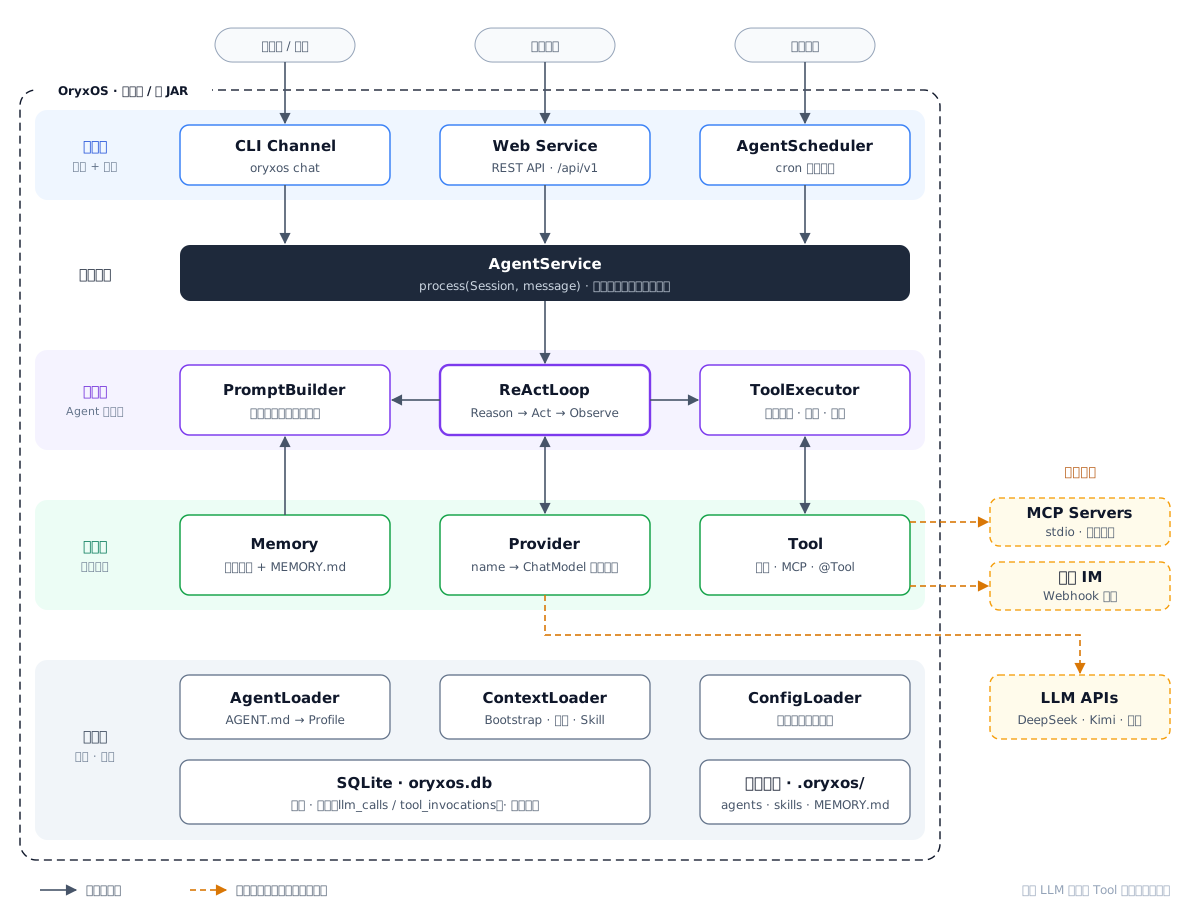
Layers
| Layer | Components | Responsibility |
|---|---|---|
| Entry | CLI Channel, Web Service (REST), AgentScheduler | Messages in and out. CLI and REST are human-triggered; the scheduler is clock-triggered |
| Unified entry point | AgentService | The single orchestrator shared by all three entries, agnostic to the source |
| Engine | ReActLoop, PromptBuilder, ToolExecutor | The Agent's brain |
| Capabilities | Provider, Memory, Tool | LLM calls, context and execution for the engine |
| Foundation | AgentLoader, ContextLoader, ConfigLoader, SQLite, file system | Agent definitions, configuration and secrets, persistence |
In one sentence: Provider, Memory and Tool feed the ReAct engine, and the engine is exposed through three entries — CLI, Web Service and the scheduler.
Everything runs in one process. External dependencies — LLM vendor APIs, external MCP servers, enterprise IM — sit outside the application boundary, and every crossing is sandbox-checked and audited.
How a message is processed
A message arrives from the CLI / REST API / scheduler
  → AgentService.process(Session, message)
    → PromptBuilder assembles the prompt
       (AGENT.md body + bootstrap files + Skill metadata + current time + long-term memory + history + tools)
    → ProviderService calls the LLM                                  ── writes llm_calls
       ├─ no tool call → return the final answer
       └─ tool call → ToolExecutor: look up → sandbox check → run    ── writes tool_invocations
                      → append the result to history → assemble the prompt again
    → stop at the iteration limit (default 10)
  → persist the session
Core capabilities
LLM access
ProviderService manages all providers and hides vendor differences from the ReAct loop. With several providers side by side, it keeps an explicit provider name → ChatModel map instead of guessing from bean types. Every call records token usage, provider and model in llm_calls.
ReAct loop
ReActLoop is the most important code in OryxOS. It is implemented in-house rather than on Spring AI's Agent abstractions. Spring AI does exactly two things here: provider protocol conversion and JSON Schema generation for @Tool. Its automatic tool execution is disabled; ToolExecutor alone schedules tools, so no tool ever runs twice.
Memory
MemoryService is the single facade over all memory layers; the ReAct loop only talks to it:
- Session memory: delegated to
SessionManager, persisted in SQLite and restored after restarts; early turns are truncated when too long - Long-term memory: delegated to
LongTermMemoryStore, by default.oryxos/memory/MEMORY.mdwith a core and an archival section. The core section is never truncated; truncation and search apply to the archive only. It is re-read on every turn with no cache, so new memories are visible immediately - Episodic memory: coming in the extension phase
Agents write and search memory with the built-in save_memory and recall_memory tools.
Tools
Every tool — built-in, MCP or @Tool Bean — is wrapped as a uniform OryxTool, so the loop never cares where a tool comes from:
| Tier | Effort | How |
|---|---|---|
| Zero code (recommended) | Lowest | Write an Agent directory and reuse MCP servers via mcp_servers.yaml |
| Light code | Medium | Write an MCP server in any language; OryxOS connects as an MCP client |
| Full code | Highest | Write a Java Spring Bean with @Tool, called in-process |
AGENT.md and Skills are not tools. The Agent body is injected into the system prompt by ContextLoader. Bound Skills contribute only their name, description and path each turn; the model reads a Skill's body with read_file when it needs it (progressive disclosure).
Web Service
The Web Service is OryxOS's front door. The core phase ships 10 REST endpoints: 4 for sessions, 1 for Agent invocation, 3 for Agent / memory / tool queries and 2 for health and info. Limits: 32 KB per message, at most 100 history entries per response, a 60-second timeout per invocation.
Security: sandbox and audit
Sandbox
The sandbox is interface-first: a neutral Sandbox.enforce(action) interface with one implementation in the core phase — application-level allow-lists:
| Action | Check |
|---|---|
| File read/write | Normalized path matched against the allow-list; blocks ../ traversal |
| Shell command | Only allow-listed executables; argument arrays passed directly, never through a shell |
| HTTP request | Host matched against the domain allow-list |
| SMTP | Exact host:port allow-list |
Later phases add container and microVM isolation — the interface stays the same; only new implementations are added.
WARNING
Application-level allow-lists stop a model's mistakes, not a determined attacker. Do not run fully untrusted code or offer multi-tenant service on the core-phase sandbox.
Audit
Every LLM call is written to llm_calls; every tool call — including failures and sandbox rejections — to tool_invocations. Audit data is stored in the database from day one, not reconstructed from logs later.
Key technical decisions
| # | Decision | Choice | Why |
|---|---|---|---|
| 1 | ReAct implementation | Home-grown | Full control; room to customize the loop |
| 2 | Spring AI boundary | Protocol conversion + schema generation only; auto tool execution disabled | No double tool calls; OryxOS owns the loop |
| 3 | Execution model | Synchronous + Java 21 virtual threads | Plain code, high concurrency on one node |
| 4 | Tool registration | @Tool + OryxTool abstraction | One interface for built-in and MCP tools |
| 5 | HTTP layer | Spring MVC + virtual threads | Straightforward; streaming later via SseEmitter |
| 6 | Sandbox | Interface-first + application allow-lists | SecurityManager is gone in JDK 21; swapping implementations never touches callers |
| 7 | Persistence | SQLite + Spring Data JPA + MEMORY.md | Single-binary deployment; audit tables written from day one |
Persistence
| Data | Store | Notes |
|---|---|---|
| Sessions | SQLite sessions | History serialized as JSON; survives restarts |
| Audit | SQLite tool_invocations, llm_calls | One row per call |
| Schedules | SQLite scheduled_tasks, task_executions | Task state and run history |
| Notification channels | SQLite notify_channels | Global registry referenced by name |
| Agent definitions, bootstrap files, long-term memory, MCP config | File system .oryxos/ | Editable, git-trackable, easy to back up |
Modules
OryxOS is a Maven multi-module project with 9 modules in the core phase:
| Module | Responsibility |
|---|---|
oryxos-core | Core abstractions and engine: ReActLoop, PromptBuilder, ToolExecutor, AgentService, AgentLoader, ContextLoader, AgentScheduler |
oryxos-provider | LLM provider abstraction with explicit name mapping |
oryxos-memory | MemoryService facade, long-term memory store, memory tools |
oryxos-tool | Built-in tools, MCP client, ToolRegistry, sandbox, notifications |
oryxos-channel-cli | CLI chat channel |
oryxos-web | REST API, global error handling, OpenAPI docs |
oryxos-storage | SQLite persistence |
oryxos-cli | Picocli entry point, configuration and secret loading |
oryxos-boot | Spring Boot bootstrap and aggregation |
Modules are decoupled through interfaces: oryxos-core depends on no other module, and implementations depend on interfaces declared in core. New channels or tools are added as new modules without touching the engine.