
What is OryxOS
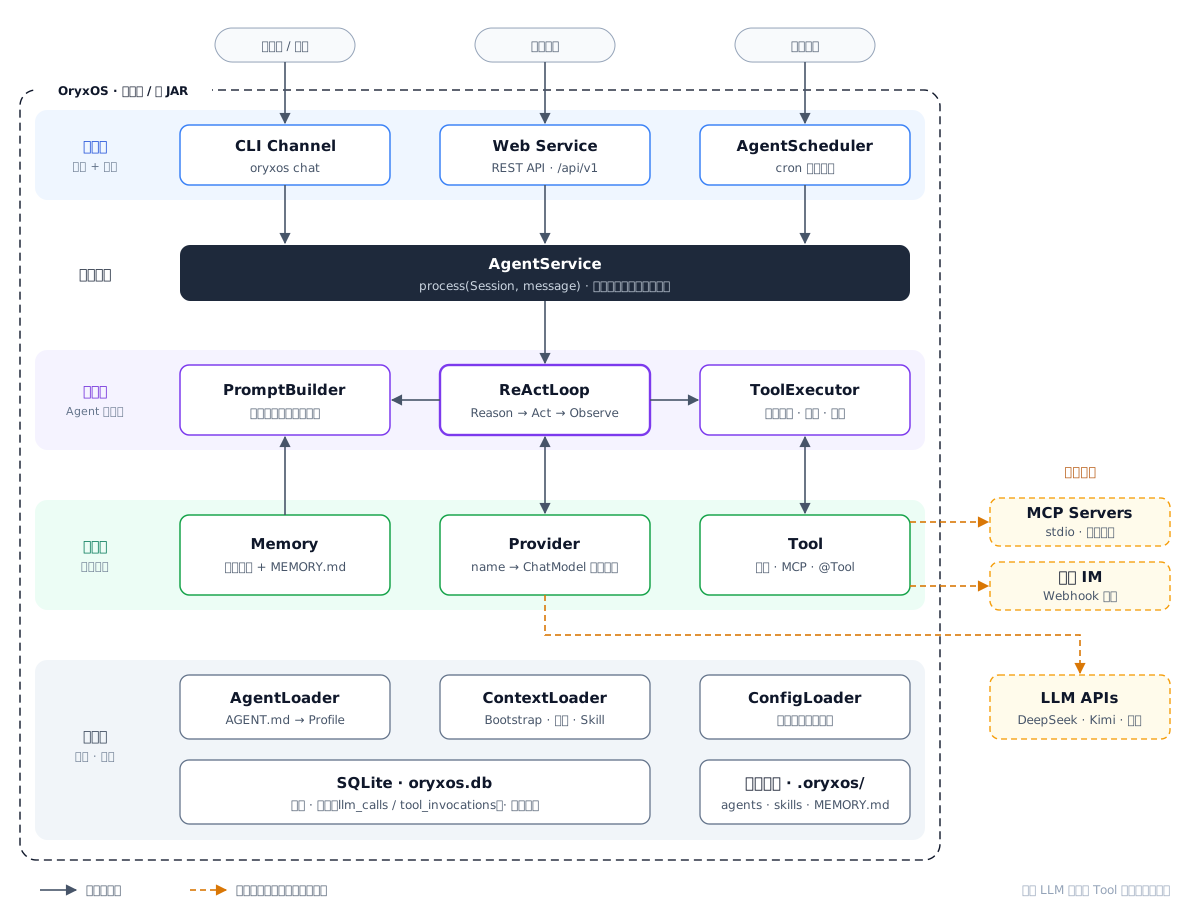
OryxOS is an open-source Agent Harness OS: an Agent runtime you install on your own Kubernetes cluster, VMs or bare metal. It gives every business Agent (ops, support, knowledge, sales assistants and more) shared model access, a reasoning loop, memory, tool calling, sandboxing and audit.
One directory defines an Agent; one runtime hosts them all. Self-hosted — your data never leaves.
Teams do two things: write an Agent directory (a single AGENT.md) and wire up a few tools. Where messages come from, how the LLM is called, how context carries over and how audits are recorded — that is OryxOS's job.
Why OryxOS
Every company has work that belongs to Agents, yet most Agents never leave the demo. They get stuck on four barriers:
| Barrier | Today | The OryxOS way |
|---|---|---|
| Defining an Agent takes code | The people who know the business can't do it | One AGENT.md, written in natural language |
| Cloud platforms take your data | Regulated industries can't pass compliance | Self-hosted; data stays on your infrastructure |
| Execution is a black box | No audit, no allow-lists — nobody ships it | Mandatory sandbox; every LLM and tool call is audited in the database |
| Running a fleet is hard | Nobody provides an OS layer for many Agents | One runtime manages the lifecycle and shared services of many Agents |
The deeper point: what keeps Agents from working reliably in production is rarely the model — it is the environment they run in. OryxOS is not yet another Agent; it is the runtime that lets a fleet of Agents run reliably.
Agent runtime vs. Agent Harness OS
- Agent runtime: the execution kernel that runs a single Agent — calling the model, executing tools, managing context, controlling the reasoning loop.
- Agent Harness OS: sits above the runtime and manages a fleet — Agent lifecycles, shared inbound channels and outbound integrations, shared memory, multi-tenancy and governance.
In operating-system terms, the runtime is a process's execution environment; the Agent Harness OS is the layer that manages many processes, schedules resources and provides shared services. A runtime runs one Agent; OryxOS runs and manages all of them.
The north-star formula:
Natural language (AGENT.md) + Memory + Tools + MCP + Skills + Knowledge + Notify = an AgentFive core capabilities
| Capability | Description |
|---|---|
| LLM access | A provider abstraction over DeepSeek, Qwen, Kimi and other mainstream models; Agents never see the vendor. Multiple providers are distinguished by explicit mapping; local inference is supported |
| ReAct loop | A home-grown reasoning engine: the LLM decides whether to call a tool → OryxOS executes it and feeds back the result → reasoning continues until an answer or the iteration limit |
| Memory | Session memory plus long-term memory; long-term memory lives in a human-readable MEMORY.md with keyword search, with room to upgrade to vector search |
| Tools | Nine built-in tools (files, shell, HTTP, memory, notify); three extension tiers: zero-code Agent directory + MCP, light-code custom MCP server, full-code @Tool Bean |
| Web Service | Every capability is exposed over a REST API, so any language can integrate over HTTP |
Key features
- 🤖 One directory = one Agent: any directory with an
AGENT.mdis an Agent — no code, many Agents per instance - ☕ Java-native: JDK 21 + Spring Boot 3, a single executable JAR that fits your existing Java toolchain
- 🔒 Under your control: runs on your infrastructure, data never leaves, no cloud lock-in
- 🛡️ Secure by design: file, command and network allow-lists on every tool call; secrets via environment variables; end-to-end audit
- 🧠 Home-grown ReAct: the core loop is implemented in-house, not borrowed from an Agent framework
- 🔌 Open standards: MCP for tools, A2A for collaboration, Agent directories modeled on Anthropic Agent Skills
- ⏰ Scheduled runs: Agents can run on a cron schedule and push results to your team IM
- 🌐 Stateless and scalable: stateless instances with externalized state, ready for a distributed future
Design principles
- The runtime over any single Agent: the key deliverable is an environment where any Agent runs reliably
- Own the core: the reasoning loop is home-grown; model protocol adapters reuse mature libraries
- Configuration is the Agent: an Agent is defined by configuration, not code
- Open standards: interoperate with the ecosystem instead of inventing protocols
- Stateless instances, external state: the prerequisite for scaling out
- Security is the foundation, not a patch: controlled sources, least privilege, mandatory sandbox, no plaintext secrets, full audit
- Deliberate phasing: get the single-node kernel right first; every architectural upgrade must be justified by real usage
How OryxOS relates to other projects
| Category | Examples | Relationship |
|---|---|---|
| Agent OS | OpenClaw, Hermes Agent | Same category, different focus: they target individuals and small teams; OryxOS targets regulated enterprises |
| Orchestration platforms | Dify, Coze | Complementary: they can sit on top and call OryxOS's API |
| Agent frameworks | Spring AI, LangChain4j | Reused: OryxOS's LLM layer is built on Spring AI Alibaba |
In short: a framework hands you materials to build a house; an orchestration platform scripts a workflow; OryxOS hands you a move-in-ready, governable, auditable home for your Agents.
Next steps
- Quick Start: build from source and see how 1.0 will be used
- Architecture: layers, key decisions and modules
- Roadmap: from a single-node kernel to distributed Agent collaboration